Guide
Wedding photo booth alternatives, and why the best one has a photographer in it
Portrait lounge. Pop-up studio. Portrait booth. Vanity Fair booth. The category has half a dozen names and no agreed definition, which makes it very hard to compare quotes. Here is what the thing actually is, what it costs next to an ordinary booth, and the hundred years of photography sitting behind it.
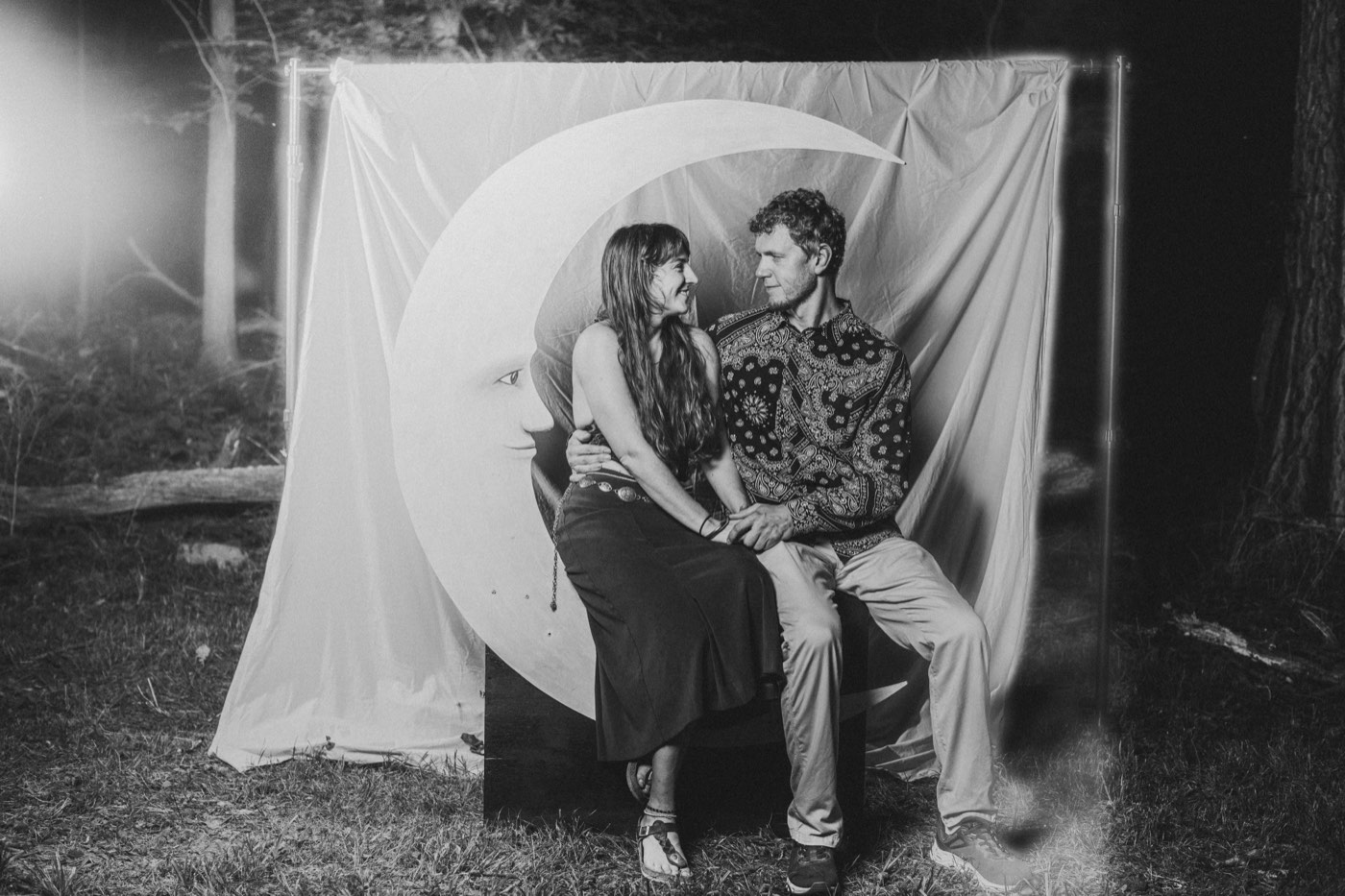
The short answer
A wedding portrait studio is a working photographer, studio lighting and a backdrop, set up in a corner of your reception for a few hours, photographing your guests one short sitting at a time. It costs roughly what a good photo booth costs. The difference is the photographer: a booth is a machine designed to work without one, and a portrait studio is built around one.
If you take one thing from this page, take that. Everything a photo booth does badly, it does badly on purpose, because it was invented in 1925 to do the job with nobody operating it.
One
What a wedding portrait studio actually is
It is not a piece of equipment. It is a person with equipment. Somebody sets up a backdrop and real portrait lighting in a corner of your reception, usually while cocktail hour is starting, and then photographs your guests for three or four hours. People come over in ones and twos and small piles. Each sitting takes two or three minutes. They get directed, the way you would be directed in a portrait session you booked and paid for yourself.
The names are all over the place. Portrait lounge, pop-up studio, portrait booth, editorial portrait station, and, after the magazine's Oscar party portraits, a Vanity Fair booth. They mostly describe the same idea. That much disagreement about what to call something is usually a sign the category is still forming, which it is.
What stays consistent underneath the names: a real camera, real lights, a real photographer, and something at the end that looks like a photograph rather than a strip of four frames with a filter on it.
Why anyone books one
Your wedding photographer is with the two of you. That is the job, and it is the right job. Nobody is with the other hundred people.
Look at a finished wedding gallery and count how many guests appear in it as the subject of a photograph rather than as background behind one. It is a short list, and it is mostly the wedding party. Everyone else booked flights, bought an outfit, and got photographed from behind at the bar.
Most people have never owned a good photograph of themselves. This is a way to fix that for a hundred of them in one evening.
Two
Photo booth or portrait studio: the real difference
The difference is who takes the picture. A photo booth automates the photographer away. A portrait studio staffs the position. Every other difference on this list follows from that one.
| Photo booth | Portrait studio | |
|---|---|---|
| Who runs it | An attendant, or nobody | A photographer, all night |
| Lighting | Fixed, built into the machine | Studio lights, set for that room |
| Direction | A props box and a countdown | Somebody telling you what to do with your hands |
| What it produces | A strip of frames, template and all | One edited portrait per sitting |
| What guests do | Pull faces | Sit still and get looked at properly |
| Retouching | Often an automatic smoothing filter | Edited by the person who shot it |
| Best at | Volume, silliness, late-night energy | One good picture of each person who came |
Neither column is the wrong answer. They are different purchases that happen to occupy the same slot on a wedding budget.
A photo booth is genuinely good at what it is for. If what you want is your college friends in novelty sunglasses at half past eleven, book a booth. They are excellent at that and a portrait studio is worse at it, because a photographer standing there tends to make people behave.
A portrait studio is for the other thing. It is slower, it is quieter, and what comes out of it is the kind of picture people put on a shelf.
Three
What each one costs
Most wedding photo booth packages run about $400 to $1,500 for three to four hours. Premium formats sit at the top of that and above it: glam booths roughly $1,100 to $2,300, and 360 booths roughly $1,000 to $2,500. Selfie stations start lower, around $250 to $400.
A staffed portrait studio is usually quoted per wedding rather than off a menu, because hours, guest count and printing all move it. Printing is the big one, and it is not a markup: paper and ink are a real cost that scales with your guest list, while a digital-only booth has almost none.
One honest warning about all of those numbers. Published cost guides disagree with each other by several hundred dollars for what is nominally the same product, because the category is unregulated and the labels are inconsistent. Treat any range you read, including this one, as a starting point rather than a benchmark, and compare what is actually included instead.
What actually moves the price
- How many hours, and whether setup and teardown are inside or outside the clock
- Whether prints are included, at what size, and whether there is a cap on how many
- Whether a second person is staffing it, which is the hidden cost behind on-site printing
- Travel beyond a stated radius, which is the most common place a low headline number grows
- How fast the gallery arrives, and whether guests can download from it for free
Four
The booth was built to remove the photographer
In September 1925, an immigrant from Siberia named Anatol Josepho opened a machine at 1659 Broadway in Manhattan. A quarter bought you eight photographs, developed in eight minutes, with nobody involved at any point.
It was a sensation. About 280,000 people used it in the first six months. On the busiest days the queue ran to 7,500. The block earned itself the nickname Broadway's greatest quarter-snatcher. In 1927 Josepho sold the patent for a million dollars, and Franklin Roosevelt sat on the board of the company formed to spread the machines across the country.
Read the invention plainly and the entire modern argument falls out of it. The photo booth's purpose was to make a portrait without a portrait photographer. That was the innovation. It was brilliant, it worked, and every booth at every wedding for the last century is descended from it.
Which means the alternative to a photo booth was never going to be a better machine. It is the thing the machine replaced.
Five
The hundred years before the machine
Before 1925, if you wanted your picture taken somewhere that was not a portrait studio, a photographer brought the studio to you. That was an ordinary job, and the people who did it went where the crowds were: fairs, boardwalks, resorts, midways.
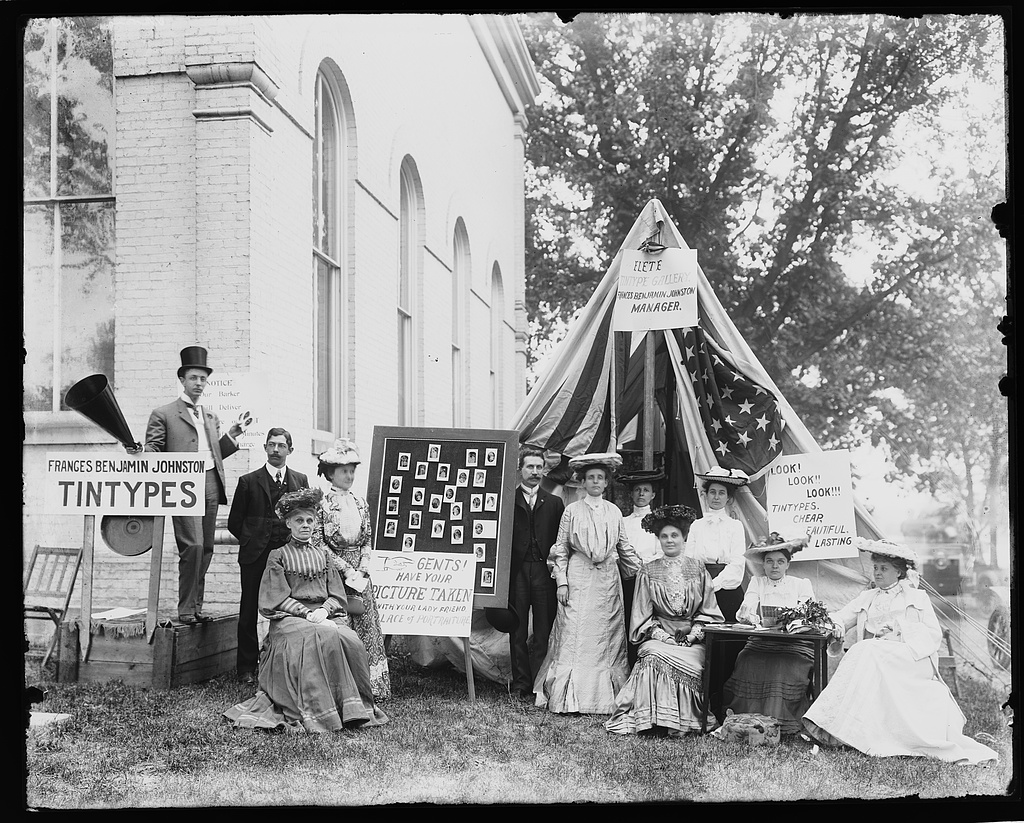
The photographer under that sign is Frances Benjamin Johnston, one of the most accomplished American photographers of her generation, who also photographed the White House and built one of the great architectural archives in the country. And here she is running a portrait booth at a county fair.
The business model in that photograph has not changed in a hundred and twenty years. Go where people already are, dressed up and in a good mood. Photograph them properly. Show them the samples. Hand them something to keep.
Paper moons
The most popular of those fairground setups was the paper moon. A cut-out crescent, usually with a face on it, in front of a backdrop painted with stars. You climbed in and got photographed sitting in the sky. They ran from the late 1800s into the 1930s, and after Halley's Comet passed in 1910 the painters started adding comets to the backdrops.
It was not a random prop. It rode the same wave as the moon songs coming out of Tin Pan Alley in exactly those years, Shine On, Harvest Moon in 1908 and By the Light of the Silvery Moon in 1909, and it outlived the studios themselves in the song everybody still knows the title of.
The studios that turned out to matter
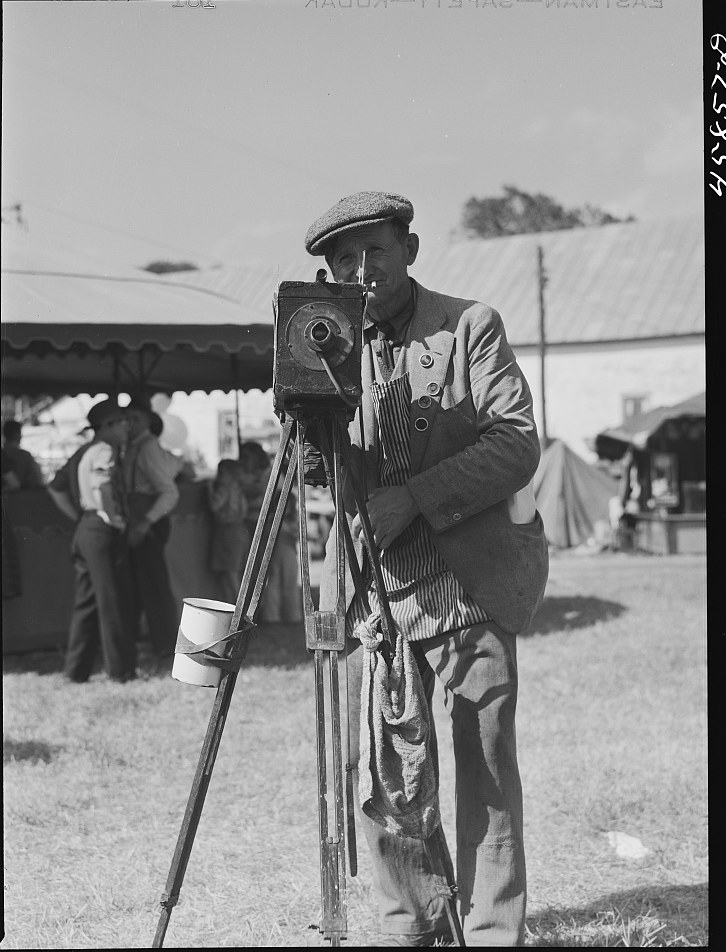
The portrait studios that history ended up caring about were not the fashionable ones. They were the ones that photographed everybody.
Between 1915 and 1959, a man who called himself Mike Disfarmer photographed the residents of Heber Springs, Arkansas, for pennies. He was simply the town photographer. Nobody involved thought of it as art. His glass negatives sat with a former mayor for years after his death, and when the International Center of Photography printed from them in 1977 the work turned out to be one of the great records of ordinary American life in the twentieth century.
And in Bamako, Seydou Keïta worked from 1948 to 1962 and made something like thirty thousand portraits. On Saturdays people queued outside his door. They arrived in their best clothes, borrowed his props, and posed as the version of themselves they wanted to see. Malick Sidibé did the same for the city's nightlife, following people to the parties and photographing them dancing and dressed up.
That last one is the closest historical relative to a portrait studio at a wedding. People at their own celebration, in the best clothes they own, photographed properly by somebody who knows what they are doing, and handed a picture at the end of it.
Nobody thought Disfarmer's portraits were art either. They were just the pictures a town happened to have of itself.
Six
What separates a good one from a backdrop and a flash
Quality varies enormously, and the price does not tell you which you are getting. Anyone with a light and a bedsheet can call it a portrait lounge. These are the things that actually change what you end up with.
- Who is holding the camera on the night. Some companies set the gear up and leave an assistant to press the button. Ask specifically whether the photographer whose work you looked at is the person running the sittings.
- Real lighting. A ring light on a stand is not portrait lighting. Studio strobes shaped for the room are what makes a portrait look like a portrait instead of a snapshot with a flash on it.
- Direction. This is the part people underestimate. Most guests have no idea what to do with their hands and will stand there smiling stiffly until somebody tells them. Direction is most of the difference.
- Sitting length. Two to three minutes is the range where a person relaxes enough to look like themselves. Much shorter and you are running a booth with a human attached to it.
- Throughput. Fifteen to twenty sittings an hour is realistic for one photographer. Over four hours that is around sixty, which covers most of a hundred to hundred-and-fifty person guest list because people sit in pairs and groups.
- What people leave with. A physical print is a different object from a download link, and it is the thing that turns up on a fridge two years later.
- How fast the gallery lands. Some deliver the next morning. Some take six weeks. Ask.
A note on filters
Several booths in the black-and-white glam category advertise an automatic skin-smoothing filter and describe the result as a virtual makeup artist effect. That is their own marketing language, not a characterisation of it. It is a legitimate product with a real audience and people love it.
Just go in knowing that a filter and a photographer are two different purchases. One removes what is on the face. The other lights it.
Seven
Nine questions that decide how the night goes
Not a technical checklist. These are the things that actually change whether this was worth booking, and they work on anybody in this category, including me.
- Will our guests actually use it?The honest answer is that it depends on whether anybody invites them. A machine waits to be noticed. A person catching someone's eye as they walk past is the difference between forty sittings and eight.
- Will there be a queue?Ask how long one turn takes and how many people they get through in an hour. Multiply by your hours. If the answer is smaller than your guest list, you want to know that now and not at ten o'clock.
- Do we have to do anything on the day?The answer should be no. Ask when they arrive, when they pack down, and whether either of those eats into the hours you are paying for.
- Will it get in our photographer's way?Ask where they plan to set up and whether they have worked alongside a wedding photographer before. A good answer mentions staying out of the room during speeches and the first dance without being prompted.
- Are the two of us in these pictures?Easy to forget, and worth asking. You will be busy all night. Ask whether they will come and find you, because a portrait of the two of you from inside your own reception is usually the best thing that comes out of it.
- Do our guests pay for anything?Ask outright. Some companies charge guests to download their own photograph, and you would rather find that out before a hundred people discover it at once.
- What do people physically leave holding?A print and a download link are different things. If it is a print, ask what size and who hands it over.
- What happens if it rains, or our corner is small?Ask what footprint and power they need and whether they can work indoors. Venues will say yes to a corner and no to a truck, and this is the question your venue is going to ask you.
- What is not included in the number you just gave me?The most useful question in the list, and the one that finds the travel fee.
Eight
Two ideas worth asking for
Ask whether the prints get revealed rather than handed out. A studio in Australia called Two Folk prints on the night but keeps everything out of sight, then reveals the whole set during the reception. Your guests walk up to a wall of portraits of themselves instead of collecting one on the way past. Same photographs, better evening, and it costs the photographer nothing to do it that way. Worth asking anyone you talk to.
Ask what happens to the pictures afterwards. A book of the night is a different object from a folder of files, and not everyone offers one. BLANC in Australia, who are probably the best known name doing this anywhere, hand-make portrait books from the evening and deliver retouched work the next morning. If a book matters to you, ask early, because it changes how the night gets photographed.
If you are not getting married anywhere near me, that is genuinely fine and this page still did its job. In the States, The Vanity Portrait Studio covers San Francisco, Los Angeles and San Diego, and Photo Booth Boutique runs a portrait lounge in Miami. Go and talk to them.
None of them are competing with me for your date, and a category this small gets better for everyone the more people do it properly.
Nine
If you are getting married around here
Full disclosure, since you have read this far: this guide is on a photographer's website and I run one of these.
I am Aaron. I have photographed weddings around Shepherdstown, West Virginia since 2018, which means DC, Northern Virginia, Maryland and the Shenandoah Valley. The studio I bring is called Draper Moon. It is a plywood crescent moon, or a clean white backdrop if a moon is not your wedding, and everything gets photographed in black and white.
Every portrait is edited and the whole gallery is online by the next morning, with free downloads for your guests. I quote each wedding rather than work off a menu, so send me your date and I will send a quote straight back. If your wedding is in 2027 and you book it before the 31st of December 2026, it is 25 percent off.
Common questions
Asked and answered
What is a wedding portrait studio?
A wedding portrait studio is a photographer who sets up studio lighting and a backdrop in a corner of your reception and photographs your guests, one short sitting at a time, for a few hours. Guests are directed and lit the way they would be in a paid portrait session. It is sometimes called a portrait lounge, a pop-up studio, a portrait booth or a Vanity Fair photo booth.
What is the difference between a photo booth and a portrait studio at a wedding?
Who takes the picture. A photo booth is a machine built to work without a photographer, so it uses fixed lighting, a countdown and props. A portrait studio is staffed by a photographer who sets the lighting for the room and directs each guest. A booth produces a strip of frames; a portrait studio produces one edited portrait of each person.
How much does a wedding photo booth cost?
Most wedding photo booth packages run about $400 to $1,500 for three to four hours. Premium formats sit higher: glam booths roughly $1,100 to $2,300 and 360 booths roughly $1,000 to $2,500. Published cost guides disagree with each other by several hundred dollars, so ask any vendor what is actually included before comparing numbers.
Is a portrait studio more expensive than a photo booth?
Not necessarily. A staffed portrait studio typically is quoted per wedding rather than off a menu, because hours, printing and guest count all move it. The bigger cost difference against a booth is usually prints, since paper and ink are a real per-guest cost while a digital-only booth has almost none.
Do we still need a wedding photographer if we book a portrait studio?
Yes. They do different jobs. Your wedding photographer covers the day and the two of you. A portrait studio covers everybody else, from one fixed position, while your photographer is busy with the parts of the day that cannot be repeated.
When was the photo booth invented?
Anatol Josepho opened the first automated photo booth, the Photomaton, in September 1925 at 1659 Broadway in Manhattan. It charged 25 cents for eight photographs developed in eight minutes. About 280,000 people used it in the first six months, and Josepho sold the patent in 1927 for one million dollars.
What is a paper moon photo?
A paper moon photo is a portrait made at a fairground studio where sitters posed in a cut-out crescent moon in front of a painted star backdrop. The setup was popular in the United States from the late 1800s into the 1930s, and comets began appearing in the backdrops after Halley's Comet passed in 1910.
How many guests can a portrait studio photograph in one night?
A sitting takes roughly two to three minutes, so a single photographer running the studio continuously manages about fifteen to twenty an hour. Over four hours that is around sixty sittings, which covers most of a hundred to hundred-and-fifty person guest list because people sit in pairs and groups.
Sources
Where all of this came from
- Photomaton, 1925: Jewish Currents, “Anatol Josepho's Photo Booth” and Anatol Josepho.
- Paper moon studios: Lyman Allyn Art Museum, “It's Only a Paper Moon: Souvenir Photography in America, 1870–1950”, and the Metropolitan Museum of Art's Paper Moon Studio Portrait.
- Painted photographic backdrops: Smithsonian Libraries.
- Mike Disfarmer: Encyclopedia of Arkansas and International Center of Photography.
- Seydou Keïta and Malick Sidibé: Harvard Art Museums and Aperture.
- Photo booth rental pricing: Bark cost guide and Event Brothers Co., checked August 2026. Ranges differ between published guides, which is noted above.
- Historical photographs: Library of Congress Prints & Photographs Division, credited individually beneath each image.