Guide
Two venues, one wedding day: what the drive really costs
Ceremony in one place, reception in another. The drive is not the expensive part. Here is what a second venue really takes out of your day.
Checked August 2026
This is one of the first real decisions you make, usually before you have hired anybody, and it gets argued as though it were about the drive. It is not really about the drive. A short drive is nothing. What a second location costs you is a block, and blocks are the only thing a wedding day is actually made of.
What the block really is
A transit block is not the length of the drive. It is the last guest leaving the first place, plus the drive, plus the first guest arriving at the second place, plus the stretch at the far end where nothing happens because half the room is still parking. Whatever number you have in your head, the honest version is longer, and it lands in the middle of the afternoon, which is the part of the day you would most like to have back.
It comes out of a specific pocket, too. It does not come out of dinner, because dinner is booked. It does not come out of the ceremony. It comes out of the loose hour that would otherwise have been portraits, or the two of you sitting down for a minute, or your uncle telling the story he only tells at weddings.
What it costs in money, which is less than you think
Worth saying plainly, because it is the thing couples quietly worry about: the drive itself does not cost you anything extra from me. Travel is included anywhere around DC, Maryland, Virginia, and West Virginia, and a second venue inside that area does not change the price.
What it can cost you is coverage. If the transit block pushes your last dance past the hours you booked, that is where the money shows up. So the question is not whether to pay for the drive. It is whether the day has enough room in it to absorb one.
Why one property does something a schedule cannot
The best argument I have for a single property is a day I photographed on the hill above the Potomac at Harpers Ferry Brewing. Ceremony under the timber pergola, dinner under a tent on the lawn, portraits at the stone overlook wall. Nobody drove anywhere. Nobody missed anything.
That second sentence is the whole point. When everything is on one property, people stop tracking the schedule. They do not go and sit in a car to preserve their outfit. They wander off and come back. The photographs from a day like that are different, and not because of the venue: it is because nobody is being managed.
It also does something for the pictures. We went back to that overlook wall twice, once while the light was soft and again when the sun broke through the clouds over the valley. On a single-property day you can do that. You are not spending your one loose window relocating, so you get to take a second run at something when the sky finally does something worth photographing. That is most of the difference between the portraits you hoped for and the portraits you settled for.
When the extra place is absolutely worth it
Plenty of days are better for having more than one place in them, and I would never talk anyone out of one that matters.
Getting married somewhere that already means something to you is the obvious case. Mary and Mark had three places in their day: a gathering at a house first, vows at Trinity Episcopal in Shepherdstown, then the reception up the road at the Bavarian Inn. Three, and nothing about it felt stretched, because none of the hops were long and every one of them was somewhere they actually wanted to be. Three good places beats two arbitrary ones.
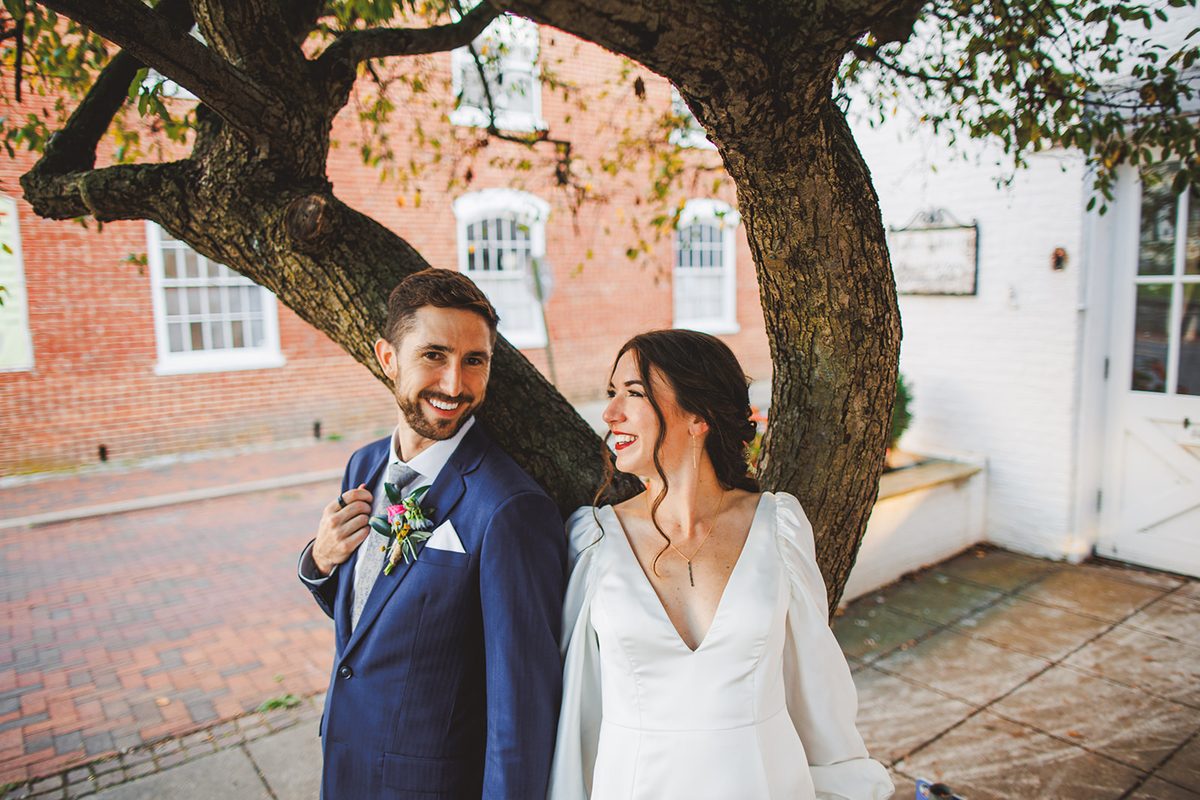
The other case is when the second place buys you something the first one cannot. Andrea and Patrick's venue sat a few blocks from German Street, so between the ceremony and dinner we simply walked into town. Brick storefronts, a crosswalk held for thirty seconds, one very good tree. That is not a transit block. That is a walk that produced photographs the property could not have given us. The same thing is true of a Loudoun vineyard where the ceremony lawn and the barn are a short walk apart.
So what do you actually do
If both places genuinely matter to you, do both, and build the day so the transit block sits somewhere it can afford to. Move it earlier. Feed people at the far end. Do not schedule your portraits for the ten minutes immediately after it, because that is the block that always runs long.
If the second place is only there because no single venue did everything, it is worth one more look for the one that does. Around here they exist, in Loudoun and Frederick and up the Panhandle, and single-property days are the easiest good days I shoot.
And if you are already booked into two, that is completely fine. Plenty of my favorite days have had a drive in the middle of them. It just wants planning for rather than discovering on the day.
Whichever shape yours takes, tell your photographer early. When you are ready, send me your date and the shape you are thinking, even if half of it is still a guess.